
Sarajevo
Ottoman lanes, Habsburg boulevards and mountain views in one compact valley city, about two and a half hours' flight from London.
- Flight from London
- Around 2 hours 30 minutes
- Ideal stay
- 3 nights
- Currency
- Convertible mark (BAM)
- Best for
- History, coffee, mountains
Why go
Sarajevo is a city where east and west meet. The Ottoman-era bazaar, Baščaršija, sits a few minutes' walk from broad boulevards of Austro-Hungarian buildings, and mosques, churches and a synagogue stand within a short walk of one another.
The city lies in a narrow valley beside the Miljacka river, ringed by mountains, so a view is never far away. The siege of 1992 to 1996 left its mark, and the museums and guides here tell that story with care. It is a place to visit with respect as well as curiosity.
When to go
Spring and early autumn bring mild weather and clear views, and the centre is pleasant to walk. Summers can be hot in the valley, and winters are cold and often snowy. August brings the Sarajevo Film Festival, so rooms are in demand then.
Where to stay
The centre is small and walkable, so you can base yourself almost anywhere in it. These four areas suit different kinds of trip.
Links in this section go to Booking.com. We may earn a commission, at no extra cost to you.
Baščaršija (the Old Town)
Best for first-timersThe Ottoman-era old town, with its craftsmen's lanes, coffee houses and the wooden Sebilj fountain.
Suits a short first visit when you want to walk to everything. It is busy by day and quiet late at night.
See places to stay in BaščaršijaMarijin Dvor
Best for museums and valueA district of broad avenues west of the centre, close to the National Museum and the Historical Museum, with tram links along the main road.
Suits travellers on a budget and anyone who wants easy transport. It is a short tram ride or a walk from Baščaršija.
See places to stay in Marijin DvorFerhadija and the Habsburg centre
Best for cafés and shoppingPedestrian streets of Habsburg-era buildings, shops and cafés running west from the old town, near the Cathedral of Jesus' Heart.
Suits couples and anyone who likes lively evenings. Good restaurants are easy to find, and it sits between the old town and the main avenue.
See places to stay near FerhadijaVratnik
Best for views and quietSteep streets above the old town, with the old city walls, the Yellow Fortress viewpoint and quiet residential lanes.
Suits active travellers who don't mind hills. Expect steps and slopes, and plan your evenings around the climb.
See places to stay in VratnikTop things to do
Most of Sarajevo's headline sights are close together, with a few further out. These are the ones worth planning your days around.
Baščaršija and the Sebilj
Free to wanderThe bazaar has been a trading quarter since the Ottoman period. Browse the coppersmiths' shops, try Bosnian coffee served in a copper pot, and sample ćevapi, small grilled sausages, at a local grill.
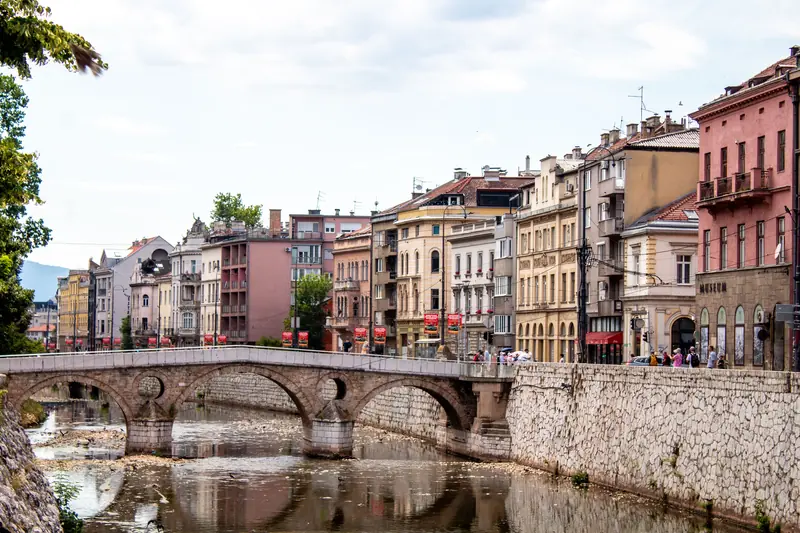
The Latin Bridge
HistoryThis stone bridge over the Miljacka stands near the spot where Archduke Franz Ferdinand was assassinated in 1914, an event that helped trigger the First World War. A small museum nearby tells the story.
The Gazi Husrev-beg Mosque
PeacefulA major mosque in the Ottoman style, built in 1530, with a calm courtyard. Dress modestly and remove your shoes where asked.
The Tunnel of Hope
Siege historyDug during the siege, the Tunnel of Hope linked the besieged city with free territory. A museum in the house at its entrance explains how it worked, with about 25 m of the original tunnel to see. It sits beyond the centre, so allow half a day.
Trebević
ViewsThe mountain above the city has a cable car, a ride of about seven minutes, that runs from near the old town to the summit, and the abandoned bobsleigh track from the 1984 Winter Olympics.
The City Hall (Vijećnica)
ArchitectureThe Pseudo-Moorish Vijećnica opened in 1896 as the city hall and later housed the National Library. It was set alight by shelling in 1992 and reopened in 2014 after reconstruction. Step inside to see its ornate interior.
Travel essentials
Getting around
The historic centre is compact and walkable, though the hills are steep. Trams, trolleybuses and buses cover longer routes. Trams run along the main road from the old town. Entry rules vary by nationality, so check the requirements for your passport before you travel.
From the airport
Sarajevo International Airport is about 10 km from the centre. Taxis are the simplest way into town: ask the driver to use the meter, or agree the fare before you set off.
Public transport
Buses and trams use paper tickets that are normally bought from kiosks or on board and validated in the vehicle. Check the current system when you arrive, and keep your ticket until you get off. Trams 3, 4 and 6 run along the main road to Ilidža, where bus 32 goes towards the Tunnel of Hope at Butmir.
On foot
The old town and much of the centre are pedestrianised. Paving can be uneven and the hills steep, so comfortable shoes matter more than a transport pass.
How many days do you need?
Three nights lets you see the old town, the Habsburg centre and the siege-era sites at a relaxed pace, with an evening in a café with a view.
With a fourth day, visit Mostar, known for its rebuilt stone bridge, around two hours away by road, or head into the Bjelašnica and Jahorina mountains, where events of the 1984 Winter Olympics took place.
Budget tips
Sarajevo is good value by Western European standards, and a few habits make it go further.
Carry some cash
Cards are accepted in hotels and larger restaurants, but many cafés and market stalls prefer cash in marks. Use bank ATMs rather than exchange booths in tourist streets.
Eat like a local
A plate of ćevapi or a slice of burek, a filled pastry, is filling and good value. Lunch menus are usually cheaper than dinner.
Tipping
Tipping is appreciated but not expected. Rounding up the bill or leaving around 10% for good service is common.
Sarajevo FAQ
How many days do you need in Sarajevo?
Three nights covers the old town, the Habsburg centre and the main museums at a relaxed pace. Add a fourth day for Mostar or the mountains.
Does Sarajevo use the euro?
No. Bosnia and Herzegovina uses the convertible mark (BAM). Cards are accepted in larger places, but keep some marks for cafés and markets.
How do I get from Sarajevo airport to the city centre?
The airport is about 10 km from the centre, and taxis are the simplest option. Ask for the meter or agree the fare before you set off.
Is Sarajevo walkable?
Yes, the old town and the centre are compact and largely pedestrianised, though the hills are steep. Trams and buses cover longer distances.
How do I get to the Tunnel of Hope?
Take tram 3, 4 or 6 to the last stop in Ilidža, then bus 32 towards Butmir, and walk down Tuneli Street to the end. Allow half a day, as it sits beyond the centre.
When is the best time to visit Sarajevo?
April, May, September and October bring mild weather and clear views. Summers can be hot, and winters are cold.
Comments and tips
Been there, or planning a trip? Share a tip, ask a question or add a photo. Every comment is read before it appears.
No comments yet. Be the first to share a tip.
Comments are not open just yet. Please check back soon.
Ready for Sarajevo?
Compare hotels, apartments and guesthouses across the city and lock in your dates.
See places to stay in SarajevoWe may earn a commission if you book, at no extra cost to you.