
Athens
Ancient monuments, rooftop views and long evenings in neighbourhood tavernas, about four hours' flight from London.
- Flight from London
- Around 4 hours
- Ideal stay
- 3 nights
- Currency
- Euro (EUR)
- Best for
- History, food, views
Why go
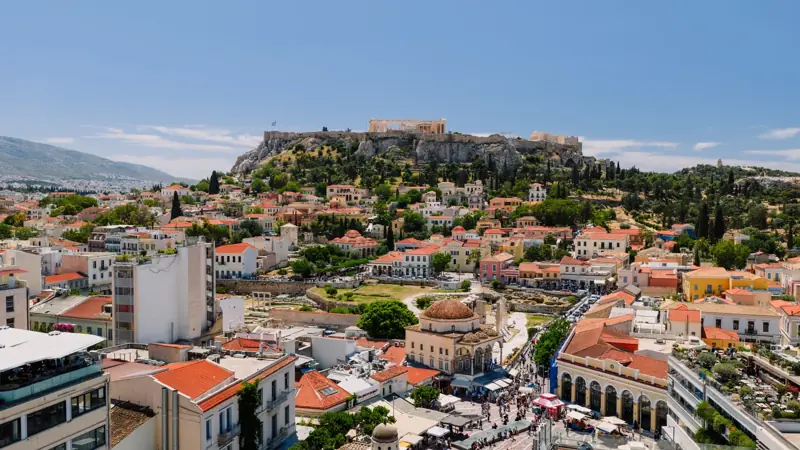
Athens is a city where the ancient and the everyday sit side by side. The Acropolis rises above the old centre, a few minutes' walk from the cafés, markets and tavernas where ordinary life carries on.
It rewards visitors who slow down: neighbourhood squares to linger in, street art around Psyrri and, a short ride away, seafood restaurants on the Saronic Gulf. Three nights is enough for the highlights.
When to go
Spring and autumn are the most comfortable seasons, with warm days and smaller crowds than midsummer. July and August can be very hot, so save outdoor sights for early morning or late afternoon. Winter is mild but wetter and much quieter.
Where to stay
Most of what you'll want to see is within a short walk of these four areas. Choose by the kind of trip you're after.
Links in this section go to Booking.com. We may earn a commission, at no extra cost to you.
Plaka and Monastiraki
Best for first-timersDirectly below the Acropolis, a tangle of pedestrian lanes and tavernas, with the Monastiraki flea market and its metro station next door. Busy by day.
Suits a short first visit when you want to walk everywhere. Ask for a room on a side street, as late nights can be noisy.
See places to stay in PlakaKoukaki
Best for the Acropolis MuseumA residential district just south of the Acropolis, close to the Acropolis Museum and the Acropoli metro station, with relaxed cafés and bakeries.
Suits couples and repeat visitors who want a quieter base within walking distance of the main sights.
See places to stay in KoukakiKolonaki
Best for elegance and shoppingA polished district on the slopes of Lycabettus Hill, with designer shops, pavement cafés and museums such as the Benaki Museum and the Museum of Cycladic Art.
Suits travellers who prefer an upmarket, calmer base. It is a short walk or metro ride from the main sights.
See places to stay in KolonakiPsyrri
Best for nightlife and street artJust north of Monastiraki, a lively district of small bars, tavernas and street art, busy on weekend nights.
Suits groups and anyone who wants the evening to begin on the doorstep. Light sleepers should choose another area.
See places to stay in PsyrriTop things to do
Most of Athens' headline sights cluster around the Acropolis. These are the ones worth planning your days around.
The Acropolis
Go at opening timeThe Parthenon and other temples date from the 5th century BC, and the site is a UNESCO World Heritage Site. Entry is by timed ticket, and a ticket can be used once, so you cannot leave and come back in. Arrive early, bring water and wear shoes with good grip, as the marble is slippery.
The Acropolis Museum
Good for middayBuilt at the foot of the rock, it displays finds including sculptures from the Parthenon. Glass floors reveal an excavated ancient neighbourhood beneath the building.
The Ancient Agora
Allow two hoursThe marketplace of ancient Athens. The Temple of Hephaestus stands above it, and the reconstructed Stoa of Attalos houses the site museum. Greener and quieter than the Acropolis.
Plaka and Anafiotika
Free to wanderAnafiotika is a cluster of whitewashed houses on the Acropolis's slope, built in the style of the Cycladic islands. Walk up from Plaka in the late afternoon.
Mount Lycabettus
Sunset viewsA pine-covered hill above Kolonaki, topped by the chapel of St George. Walk up or ride the funicular from Kolonaki for views of the Acropolis and the sea.
The Panathenaic Stadium
Olympic historyAlso known as the Kallimarmaro, this stadium is built of white Pentelic marble, the same stone as the Parthenon, and hosted the first modern Olympic Games in 1896. You can walk the track and stand on the winners' podium.
Travel essentials
Getting around
The historic centre is compact enough to cover on foot, though the hills are steep and the pavements uneven. For longer journeys, the metro, trams and buses share one ticketing system.
From the airport
Athens International Airport, Eleftherios Venizelos, has a direct metro line (line 3) to Syntagma Square and Monastiraki, taking about 40 minutes. The X95 express bus to Syntagma Square runs through the night. The airport journey has its own fare, higher than a standard city ticket.
Tickets
Buy tickets from machines in metro stations or from kiosks, and validate a paper ticket before you travel. The Ath.ena Ticket can be loaded with a 90-minute, 24-hour or 5-day fare, each running from your first touch-in. The 5-day fare does not include the airport journey. Metro line 1 runs to the port of Piraeus, where ferries leave for the islands.
Late at night
The metro and trams stop late at night, and night buses cover the main routes. Taxis are easy to find in the centre; ask for the meter, or book through a ride-hailing app.
How many days do you need?
Three nights is a good length: a day for the Acropolis and Plaka, a day for the Agora and a museum such as the National Archaeological Museum, and a day for Kolonaki and Lycabettus.
With a fourth day, visit the Temple of Poseidon at Cape Sounion, around 70 km from the city, or take a ferry from Piraeus to Aegina. Suburban KTEL Attica buses also serve Sounio, with routes leaving mainly from Pedion Areos or along the coast, so check KTEL Attica for current stops and times.
Budget tips
Athens can be done on a modest budget if you plan with care.
Look for combined tickets
A combined ticket for several ancient sites usually works out cheaper if you plan to visit more than one. Check the official ticketing website, as options and prices change.
Check for free-entry days
Some state-run sites and museums offer free or reduced entry on selected days of the year. Dates change, so check the official website.
Eat like a local
Tavernas away from the main squares are usually better value. Order a few dishes to share. A service charge is not always included, so check the bill.
Athens FAQ
How many days do you need in Athens?
Three nights covers the Acropolis, the Ancient Agora and the main museums at a relaxed pace. Add a fourth day for a trip to Cape Sounion or a ferry to Aegina.
Does Athens use the euro?
Yes. Greece uses the euro. Cards are widely accepted, but keep some cash for small tavernas, kiosks and taxis, and if a card machine offers to charge you in pounds, choose euros.
How do I get from Athens airport to the city centre?
The simplest way is metro line 3, which runs directly from the airport to Syntagma Square and Monastiraki. The X95 express bus goes to Syntagma Square and runs through the night, and taxis wait outside arrivals.
Is Athens walkable?
The central sights around the Acropolis are close together and easy to cover on foot, although the hills, uneven pavements and summer heat can be tiring. The metro covers longer distances quickly.
Which public transport ticket should I buy in Athens?
The Ath.ena Ticket can be loaded with a 90-minute, 24-hour or 5-day fare. The 5-day fare does not include the airport, so check the official OASA website for current airport tickets.
When is the best time to visit Athens?
April, May, September and October bring warm weather and manageable crowds. July and August are very hot, and winter is mild but wetter.
Comments and tips
Been there, or planning a trip? Share a tip, ask a question or add a photo. Every comment is read before it appears.
No comments yet. Be the first to share a tip.
Comments are not open just yet. Please check back soon.
Ready for Athens?
Compare hotels, apartments and guesthouses across the city and lock in your dates.
See places to stay in AthensWe may earn a commission if you book, at no extra cost to you.