
Algarve
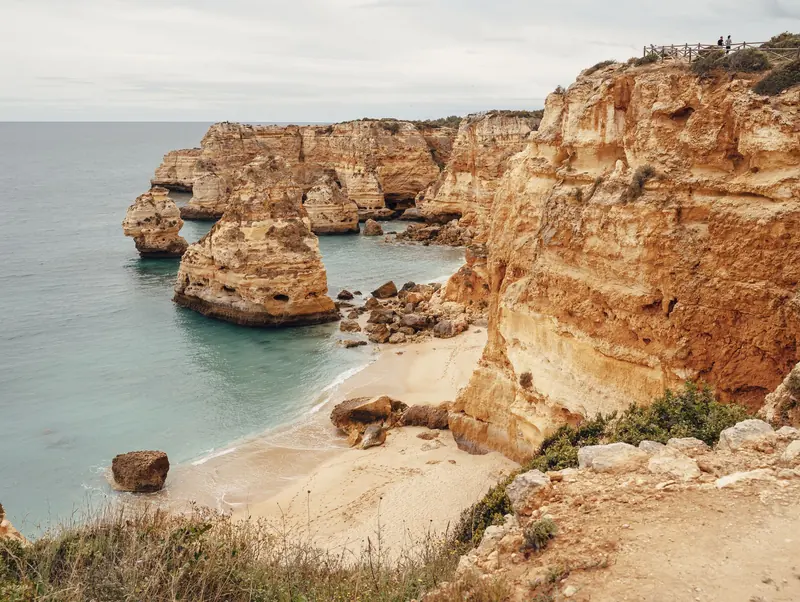
Ochre cliffs, sea caves and sheltered lagoons on Portugal's south coast, around three hours' flight from London.
- Flight from London
- Around 3 hours
- Ideal stay
- 7 nights
- Currency
- Euro (EUR)
- Best for
- Beaches, cliffs, coastal walks
Why go
The Algarve is Portugal's southern coast, known for ochre cliffs, sea caves and beaches. Near Lagos, boats run in and out of the caves and grottoes at Ponta da Piedade, and the Benagil cave, nicknamed 'O Templo', can be reached only from the sea.
Visit Portugal cites more than 3,000 hours of sunshine a year with low average rainfall. Visit Algarve gives summer air temperatures of 24 to 29 degrees and winter temperatures of 15 to 18, with the sea at 21 to 24 degrees in summer and 15 to 19 in winter.
When to go
Summer suits beach holidays, but the tourist board recommends September to June for walking and cycling, and the region is promoted as a mild winter destination. Rain is scarce and falls mostly between November and March, and the sea is cooler then. Bring a light jacket for evenings outside the summer months.
Where to stay
The coast is long, so choose between the western cliffs, the lively centre and the quieter lagoons in the east.
Links in this section go to Booking.com. We may earn a commission, at no extra cost to you.
Lagos
Best for cliffs and covesA town in the west, close to Ponta da Piedade and its sea caves, and at the western end of the Algarve train line.
Suits couples and walkers. Two 3 km trails run along the clifftop from the Ponta da Piedade lighthouse, one towards Lagos and one towards Porto de Mós, and the lookout at Atalaia overlooks the ochre cliffs.
See places to stay in LagosAlbufeira
Best for nightlifeA resort town in the centre of the coast, on the train line and on the Aerobus route from Faro airport.
Suits groups and first-time visitors. Visit Algarve lists Albufeira, with Praia da Rocha and Vilamoura, among the liveliest places on the coast at night.
See places to stay in AlbufeiraPortimão and Praia da Rocha
Best for a marina and beachA river port on a bend of the Arade, with the sheltered marina below the cliffs of Praia da Rocha.
Suits visitors who want a beach and a harbour in one place. Portimão is a stop on the Algarve train line and on the Aerobus route.
See places to stay in Portimão and Praia da RochaFaro and the Ria Formosa
Best for lagoonsThe city of Faro, the gateway to the Ria Formosa Natural Park, a lagoon protected by barrier islands.
Suits visitors who want a quieter pace and short boat trips. Boat tours leave from Faro, Olhão, Fuzeta and Santa Luzia, and Faro is where the Aerobus from the airport arrives.
See places to stay in Faro and the Ria FormosaTop things to do
The Algarve's highlights are its cliffs, caves and lagoons, plus a lighthouse at the end of Europe.
Ponta da Piedade
Cliffs and cavesNear Lagos, where a boat ride in and out of the caves and grottoes gives a striking view of the rock formations. Clifftop paths offer panoramic views, with two 3 km trails from the lighthouse.
Benagil cave
By boatKnown as 'O Templo', the cave in Lagoa is reachable only from the sea. Several operators run boat trips to the Benagil grottoes, including sunset trips, so check the sea conditions and book a licensed operator.
Ria Formosa Natural Park
Lagoon and islandsA nature reserve in the 1970s and a natural park since 1987. Five barrier islands separate the sea from the lagoon between Faro and Tavira, and boat tours run all year. Barreta, an uninhabited island, is a quiet spot.
Cabo de São Vicente and Sagres
End of EuropeOfficial Algarve material places the extreme south-west of Europe at Cabo de São Vicente, near Sagres, where the coast bends and the sea calms. The route from Lagos takes in the Sagres fortress and the lighthouse.
Praia da Marinha
Eroded cliffsA beach whose cliffs have been carved by erosion, listed among the most striking places on the coast. Check the tide before you go.
Walking and cycling
Coast pathsVisit Portugal promotes cycling and walking in the Algarve, and the Costa Vicentina covers the territory between Odeceixe and Vila do Bispo. The EuroVelo 1 route follows the coast.
Travel essentials
Getting around
Trains and buses cover the main towns, and boats are the way to reach the lagoon islands.
From the airport
The Aerobus links Faro airport with the city centre and with Albufeira, Lagoa, Portimão and Lagos. The VAMUS Algarve tourist pass covers it, and is valid for three or seven days from first use, with no limit on trips.
By train
The Algarve line is 140 km long and has 30 stations, calling at Faro, Loulé, Albufeira, Lagoa, Portimão and Lagos. A CP notice has trains every hour between Vila Real de Santo António and Faro, and every two hours between Faro and Lagos. Check the current timetable before you travel.
By boat
Boat tours of the Ria Formosa run all year from Faro, Olhão, Fuzeta and Santa Luzia, and boats serve the caves at Ponta da Piedade and Benagil. Operators and sailings depend on the sea conditions.
How many days do you need?
A week is the classic Algarve holiday. It gives you time for the beaches, a boat trip along the cliffs and a day in the Ria Formosa.
With four or five nights, choose one base on the train line and plan two excursions. Stay longer to add Sagres and the south-west tip, or a day on the coast paths.
Budget tips
The Algarve suits many budgets, and a few choices help your money go further.
Use the Aerobus and the train
The Aerobus and the Algarve line cover the main towns, and the VAMUS tourist pass covers the Aerobus for three or seven days.
Enjoy the free sights
The clifftop paths at Ponta da Piedade and the lookout at Atalaia are good places to spend time without a ticket. Boat trips to the caves are separate, so compare operators.
Travel outside July and August
Visit Algarve recommends September to June for walking and cycling, and winter is mild enough for a quieter trip.
Compare the boat trips
Several operators run trips to the Benagil grottoes and the Ponta da Piedade caves, so compare departure points, sailing times and what is included.
Algarve FAQ
How many days do you need in the Algarve?
A week covers beaches, a boat trip and the Ria Formosa. Four or five nights works for a shorter break.
Is the Algarve good in winter?
It is mild. Visit Algarve gives winter air temperatures of 15 to 18 degrees and says rain falls mostly between November and March.
Can you get around the Algarve without a car?
Yes, for the main towns. The Aerobus links Faro airport with Albufeira, Portimão and Lagos, and the Algarve line serves the coast from Vila Real de Santo António to Lagos.
Can you walk to the Benagil cave?
The cave is reachable only from the sea, so you need a boat trip. Several operators run them, including sunset trips.
How warm is the sea in the Algarve?
Visit Algarve gives sea temperatures of 21 to 24 degrees in summer and 15 to 19 in winter.
Where is the south-west tip of Europe?
Official Algarve material places it at Cabo de São Vicente, near Sagres, where the Sagres fortress and the lighthouse are on the same route.
Comments and tips
Been there, or planning a trip? Share a tip, ask a question or add a photo. Every comment is read before it appears.
No comments yet. Be the first to share a tip.
Comments are not open just yet. Please check back soon.
Ready for Algarve?
Compare hotels, apartments and resorts along the coast and lock in your dates.
See places to stay in AlgarveWe may earn a commission if you book, at no extra cost to you.