
Croatia
Walled towns, island ferries and clear Adriatic water, around three hours' flight from London.
- Flight from London
- 2 hours 50 min to 3 hours 35 min
- Ideal stay
- 7 nights
- Currency
- Euro (EUR)
- Best for
- Old towns, islands, swimming
Why go
Croatia's Dalmatian coast strings together old towns and islands along the Adriatic. UNESCO lists the Old City of Dubrovnik, whose walls are 1,940 metres long and 25 metres high, Diocletian's Palace and the historic centre of Split, and the old town of Korčula. Plitvice Lakes National Park, inland, is also a World Heritage Site.
Croatia joined the eurozone and the Schengen area on 1 January 2023, and the euro is the only official means of payment. The tourist board says the sea is clear, with visibility up to 50 metres in places.
When to go
Dalmatia has a hot Mediterranean climate, according to the tourist board, and the national meteorological service says summers on the Adriatic are typically settled and clear. July and August are therefore the hottest months for swimming, while late spring and early autumn are more comfortable for sightseeing. The service's website has sea-temperature figures if you want to check the swimming season.
Where to stay
Dalmatia is long, so choose a base by the town and the islands you want to reach.
Links in this section go to Booking.com. We may earn a commission, at no extra cost to you.
Dubrovnik
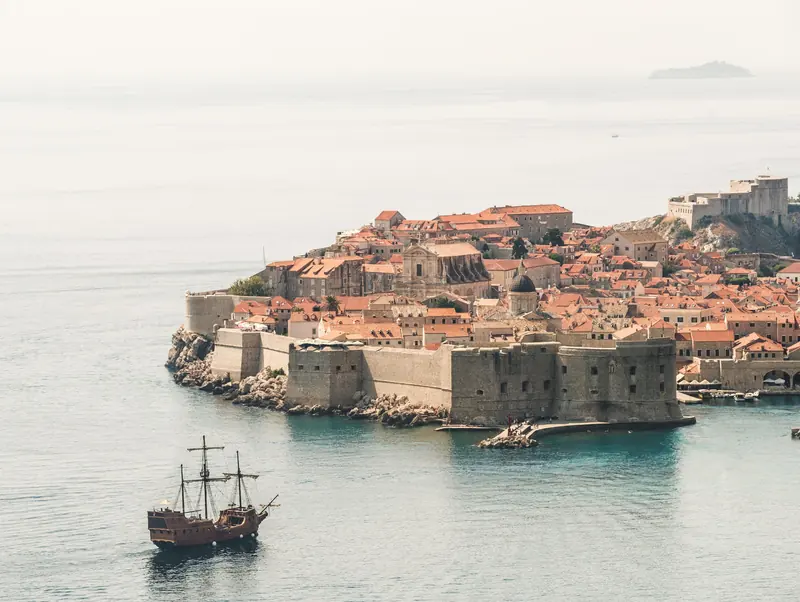
Best for a walled cityThe Old City is a UNESCO World Heritage Site, and its walls, 1,940 metres long and 25 metres high, include three of the five forts: Minčeta, Bokar and St John.
Suits first-time visitors who want a historic centre. A catamaran line runs from Dubrovnik via Korčula and Hvar to Split.
See places to stay in DubrovnikSplit
Best for a city and ferriesA city built around Diocletian's Palace, a UNESCO site, with the Peristyle square and the Cellars among its sights.
Suits visitors who want a city with island ferries. Jadrolinija runs a direct fast line from Split to Hvar Town.
See places to stay in SplitHvar Town
Best for the islandsA harbour town on Hvar, with a Renaissance fortress guarding the harbour.
Suits couples and friends. The crossing from Split takes about an hour by catamaran and about two hours by ferry.
See places to stay in Hvar TownKorčula
Best for an old townAn old walled town on Korčula, listed by UNESCO in 2007, known for the legend that Marco Polo was born there in 1254.
Suits visitors who like quiet streets and sea views. Historians still debate the birthplace, but the Marco Polo Centre displays memorials to him.
See places to stay in KorčulaTop things to do
Croatia's highlights are walls, palaces and islands, with a national park for a change of scenery.
Dubrovnik's city walls
Walking the wallsThe walls are 1,940 metres long and 25 metres high, and three of the five forts are part of them. Go early or late, as the stone is exposed to the sun.
Diocletian's Palace
SplitThe 4th-century palace and the city's historic centre were added to the UNESCO list in 1979. The Peristyle square and the Cellars are among its sights, and the Split tourist board describes the Cellars as a very well-preserved monument of Roman architecture.
Plitvice Lakes
National parkA UNESCO World Heritage Site since 1979 and known for its system of lakes. Its boundary was changed in 2000 and again in 2025.
Hvar Town
Fortress and harbourA Renaissance fortress guards the harbour. The nearby Stari Grad Plain on Hvar was listed by UNESCO in 2008.
Korčula Old Town
Walled townThe town's walls date from the 13th century until the 1870s, and the old town was listed by UNESCO in 2007.
Island hopping
By ferryJadrolinija and catamaran lines link Dubrovnik, Korčula, Hvar, Bol and Split. Services are seasonal, so check the current timetable.
Travel essentials
Getting around
Ferries and catamarans do most of the work on the Dalmatian coast, so plan your days around them.
By ferry
Jadrolinija runs a direct fast line from Split to Hvar Town, and line 9811S links Dubrovnik, Korčula, Hvar, Bol and Split, with morning departures from Dubrovnik and afternoon departures from Split. Timetables are seasonal, so check jadrolinija.hr for the current schedule.
To Hvar
The crossing from Split to Hvar takes about an hour by catamaran and about two hours by ferry. The Krilo catamaran to Dubrovnik runs from May to October.
Flights
Dubrovnik and Split both have airports, and Stansted lists flight times of about 2 hours 50 minutes to Dubrovnik and 3 hours 35 minutes to Split.
How many days do you need?
A week is the classic Croatia holiday. It gives you time for one old town, a ferry trip to an island and a day on the beach.
With four or five nights, choose Dubrovnik or Split as a base and plan one island trip. Stay longer to combine both cities with Hvar and Korčula.
Budget tips
Croatia is easiest to enjoy when you plan your ferries and your sightseeing in advance.
Pay in euros
Croatia adopted the euro on 1 January 2023, so there is no currency to exchange if you arrive with euros.
Plan the ferries
Services are seasonal, so check the current timetable before you plan an island day.
Walk the old towns
Walking the streets of Dubrovnik, Split and Korčula costs nothing, though some monuments charge for entry.
Croatia FAQ
How many days do you need in Croatia?
A week covers one old town, a ferry trip to an island and a day on the beach. Four or five nights works for a shorter break.
Does Croatia use the euro?
Yes. Croatia adopted the euro on 1 January 2023, and it is the only official means of payment.
How long are Dubrovnik's city walls?
The walls are 1,940 metres long and 25 metres high, and three of the five forts are part of them.
How long is the ferry from Split to Hvar?
About an hour by catamaran and about two hours by ferry.
Is there a boat between Dubrovnik and Split?
Yes. A catamaran line links Dubrovnik, Korčula, Hvar, Bol and Split, and the Krilo catamaran to Dubrovnik runs from May to October.
Is Korčula a UNESCO site?
The historic town of Korčula was inscribed by UNESCO in 2007. Its walls date from the 13th century to the 1870s.
Which Croatian town is linked to Marco Polo?
Korčula, where legend says he was born in 1254. Historians still debate the exact birthplace, but the Marco Polo Centre displays many memorials to him.
When was Diocletian's Palace listed by UNESCO?
The palace and the historic centre of Split were added to the World Heritage List on 26 October 1979.
Is Hvar a UNESCO site?
The island itself is not listed, but the Stari Grad Plain on Hvar was inscribed in 2008. Hvar Town has a Renaissance fortress above its harbour.
How long is the flight to Croatia?
Stansted lists about 2 hours 50 minutes to Dubrovnik and about 3 hours 35 minutes to Split. Flight times vary by airline and season.
Is Croatia in the Schengen area?
Yes. Croatia joined the Schengen area and the eurozone on 1 January 2023, though the tourist board still advises carrying a passport or ID card.
Is Plitvice a UNESCO site?
Yes. UNESCO inscribed Plitvice Lakes National Park in 1979.
Comments and tips
Been there, or planning a trip? Share a tip, ask a question or add a photo. Every comment is read before it appears.
No comments yet. Be the first to share a tip.
Comments are not open just yet. Please check back soon.
Ready for Croatia?
Compare hotels, apartments and guesthouses along the coast and lock in your dates.
See places to stay in CroatiaWe may earn a commission if you book, at no extra cost to you.